


Why Great Salons Still Don’t Rank on Google
There’s a question we hear from salon and beauty business owners a lot. We are good at our craft, our clients are happy, and they still can't figure out why they're buried on Google. It's maddening, genuinely.
Honestly, it's one of the more frustrating things to deal with, especially when you know the quality is there.
Word of mouth still works the way it always has. Someone has a great experience, they come back, and they tell a friend. That part hasn't changed. But the moment a stranger opens Google and types 'best hair salon near me,' all of that goodwill becomes invisible. The search result they see has nothing to do with how good you actually are.
The problem isn't your service. It's that Google has no way of knowing your service is good. It can't walk in, sit in the chair, and feel the difference. What it can do is look at your online presence and ask: Is this business clearly telling me what it offers, where it is, and does the rest of the internet back that up? If the answer is muddy, you don't rank, regardless of how talented your team is
And the scale of this is worth pausing on. Google has reported that 46% of searches have local intent, so we're not talking about a niche thing. Nearly half of all searches are people looking for something near them, right now. If you're not showing up for those searches, that's not a minor gap. Those are real people actively looking for what you offer.
A lot of advice around improving local SEO correctly points to foundational actions such as updating your Google Business Profile and asking for reviews. Yes, those steps absolutely matter. But where most salons fall short is consistency.
When efforts happen occasionally, visibility fluctuates. When they’re maintained steadily, they compound. Local SEO isn’t something you “finish.” It’s something you reinforce.
Why Most Local Businesses Struggle to Improve Local SEO Rankings
Most local businesses struggle to improve local SEO rankings, not because their service isn’t good enough, but because they assume quality automatically translates to visibility. It doesn’t.
In the real world, we know that reputation builds through experience. Online, it’s a different story. Google is not evaluating how skilled your stylists are or how satisfied your clients feel when they walk out. It is evaluating whether your online presence clearly and consistently communicates what you offer.
Here's where a lot of salons get stuck: they hear 'improve your local SEO' and immediately think 'get more reviews.' And reviews do matter a lot. But treating them as the whole answer is where things go wrong. They're one piece of a much bigger picture. Google is also quietly paying attention to things like:
- How consistently new reviews appear (authentic reviews)
- Whether reviews mention specific services
- How complete and active your profile is
- Whether your business information matches across directories
On their own, none of these signals does much. But when they're all pointing in the same direction– when your profile, website, listings, and reviews are all telling a consistent story, that's when visibility starts to build. Let one of them slip, and the whole thing gets wobbly. It's less like a one-time fix and more like keeping plates spinning.
How Local SEO Rankings Actually Work
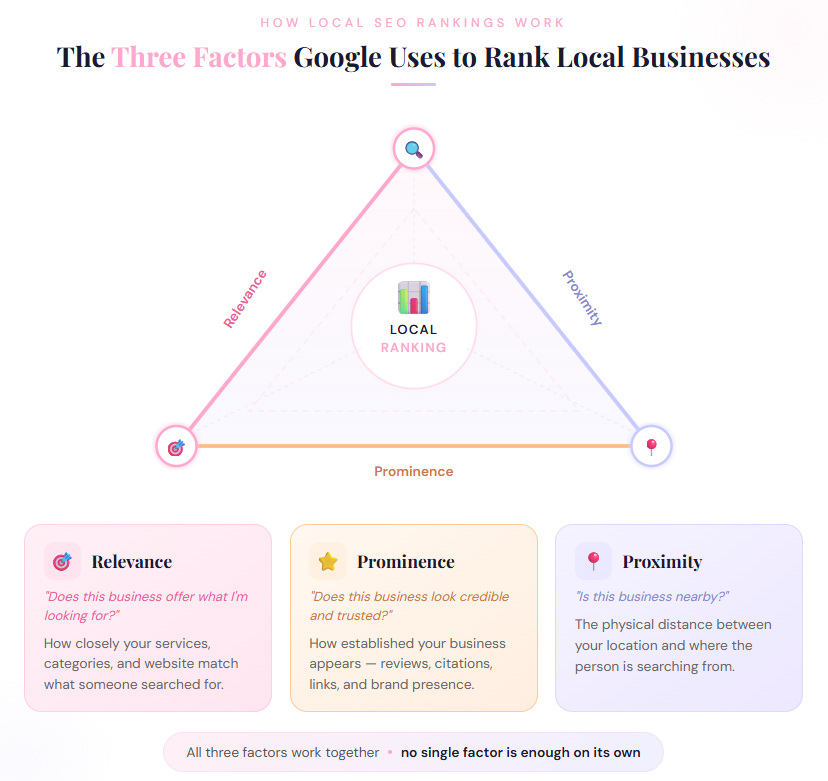
So, how does Google decide who ranks in search? At its core, it comes down to three things: how well you match what someone's searching for, how close you are to them, and how credible your business looks online. Relevance, proximity, prominence. Everything else is a variation of those three.
Relevance
Relevance is really just Google trying to answer one question: Does this business actually offer what I'm looking for?
If someone searches "bridal hair stylist in Los Angeles," Google goes looking for proof. Not just that you're a salon, but that you specifically do bridal hair, and that you're genuinely in Los Angeles. Vague or incomplete profiles make that harder to confirm, and when Google isn't sure, it plays it safe and shows someone else.
Here's what actually shapes your relevance:
- Your primary and secondary categories – These tell Google what type of business you are and what you specialize in. For example, choosing “Hair Salon” vs “Beauty Salon” changes which searches you’re eligible for.
- The services listed in your profile – When individual services such as balayage, keratin treatment, or bridal makeup are listed clearly, Google will match you when someone searches for them.
- Your website content – Adding service pages helps search engines understand what you offer in detail rather than mentioning them on a broad homepage description.
- Natural keyword alignment – The language you use matters. If your clients search for "lash lift" but your profile says "eyelash enhancement," that's a disconnect. Write the way your clients actually talk, not the way the industry does.
- Profile and website consistency – This one trips people up more than you'd think. If your Google Business Profile says one thing and your website says something slightly different, in service names, different location wording, Google sees a conflict. And conflicting signals weaken your relevance. Keep them saying the same thing.
The instinct is usually to add more; more keywords, more content, more everything. But relevance is actually about clarity. The cleaner and more consistent your signals are, the easier it is for Google to match you to the right searches.
Proximity
Proximity refers to the physical distance between your business and the person searching. When someone types “nail salon near me” or “facial spa in Brooklyn,” Google uses the searcher’s location to determine which businesses are geographically closest.
It's basically Google asking: how close is this business to the person searching right now?
What influences proximity:
- Your verified business address – Google uses the address in your Google Business Profile to calculate distance from the searcher. Accuracy plays an important role here.
- The searcher’s location at the time of search – Results vary depending on where the person is physically located, even within the same city. You can't control this, but it's worth knowing it's happening.
- Clear geographic signals on your website – Location-specific service pages can help Google understand which neighborhoods or areas you actively serve. A page targeting "hair salon in [nearby neighborhood]" tells Google you're relevant for that area too.
- Consistency across listings – When your address appears the same across directories and platforms, Google has stronger confidence in your geographic data.
You cannot change your physical location. But you can make your geographic footprint unmistakably clear.
Prominence
Prominence refers to how well-known, established, reputed, and trusted your business appears online. Prominence is the hardest of the three to build, and the most rewarding when you do. It helps Google decide how much authority your business carries.
Think of it this way: two salons could have identical profiles and identical addresses. Prominence is what separates them. It's the accumulated weight of your reviews, your mentions across the web, your listings, your website, all of it telling Google that this business is real, active, and trusted.
Think of it as Google asking: Does this business look credible?
What shapes prominence:
- Reviews and review consistency – It's not just about having a lot of reviews. Google pays attention to whether they're coming in regularly, what they actually say, and whether you're responding to them. A profile that got 80 reviews two years ago and nothing since looks stagnant. Fresh reviews signal an active business. Also worth noting– Google detects and removes spam reviews, so don't waste time or money trying to game that.
- Links from other websites – Mentions or links from local blogs, news sites, or industry websites signal that your business is recognized beyond your own listing.
- Citations across directories – Listings on platforms such as Yelp, Apple Maps, and other directories strengthen your business’s legitimacy when information is consistent. Each consistent listing is another data point confirming that your business is legitimate and where you say it is.
- Brand presence – Searches for your salon name, social media mentions, and overall online visibility contribute to your business’s online authority. It's the online equivalent of being well-known in your area.
- Website strength – A well-structured website with clear service pages and useful content supports overall trust and credibility. Thin, generic websites don't do much for prominence. Ones that clearly explain what you do and where you do it? Those help.
Prominence doesn't happen quickly. There's no hack for it. It builds as your business gets consistently mentioned, reviewed, and referenced across the web, and it compounds the longer you keep at it.
How to Improve Local SEO Rankings in Competitive Areas
In a smaller town, doing the basics of local SEO is often enough to stand out. In a bigger city or a saturated neighborhood, think three hair salons on the same block, the basics are already the floor, not the ceiling. Everyone's doing them. The question is who's actually keeping up with it.
That's usually the real difference. Not some secret tactic. Just consistency when everyone else has quietly stopped.
When you've got multiple salons offering similar services within the same few blocks, the margins are small. A slightly more complete profile here, a steadier stream of reviews there; these things add up. The businesses holding the top spots aren't necessarily the best ones. They're usually just the most consistently maintained ones.
Optimize Google Business Profile
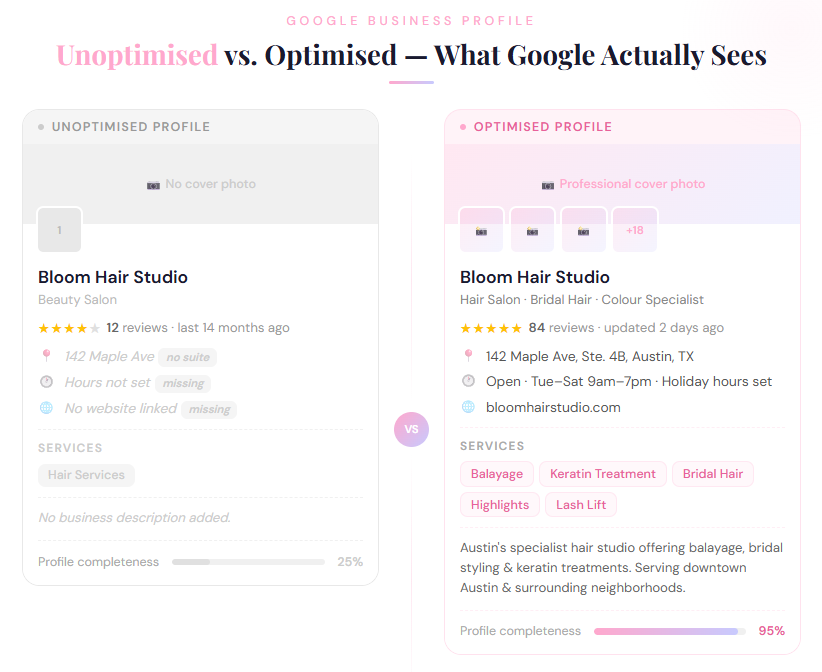
If someone finds you through Google Search or Maps, your Business Profile is probably the first thing they actually look at, before your website, before your Instagram, before anything else. In a competitive market, a half-finished profile isn't just underwhelming. It actively costs you clicks.
And those clicks matter more than you think. Research shows that 42% of searchers click on one of the top three Map Pack results. If you're not in that pack, or you're in it but your profile looks sparse compared to the salon next to you, you're losing people who were already looking for exactly what you offer.
The areas that tend to make the biggest difference:
- Categories – Your primary category is doing more work than most people give it credit for. It should reflect your core service, and your secondary categories should support your positioning.
- Services – Don't just list "Hair Services" and leave it at that. Break it down. Balayage, keratin treatment; each one listed individually is another search you become eligible for. Generic labels save you two minutes of setup and cost you months of visibility.
- Photos – Updated, high-quality photos boost your online profile. A profile with a handful of blurry or outdated photos next to a competitor with fresh, well-lit shots of their work? Clients notice. Google notices, too. Profiles with active photo updates tend to get better engagement, which feeds back into your rankings over time.
- Completeness – Every applicable field, such as active hours, contact details, address, business description, etc, should be filled out accurately and consistently across all platforms.
- Ongoing activity – Responding to reviews, updating information when needed, and keeping details current shows that your business is active and maintained.
Maintain a Steady Flow of Reviews
In Local SEO, review performance often becomes a differentiator, and having a clear Google review strategy can strengthen visibility over time. Many salons or beauty businesses focus on total review count. And yes, volume matters, but what actually moves the needle more is momentum.
Google isn't just looking at how many reviews you have. It's looking at the pattern. Are new ones coming in regularly? Or did you get a burst of reviews 18 months ago and nothing much since? That gap, even if your average rating is a 4.9, makes your profile look like a business that's coasting. And coasting doesn't rank as well as active.
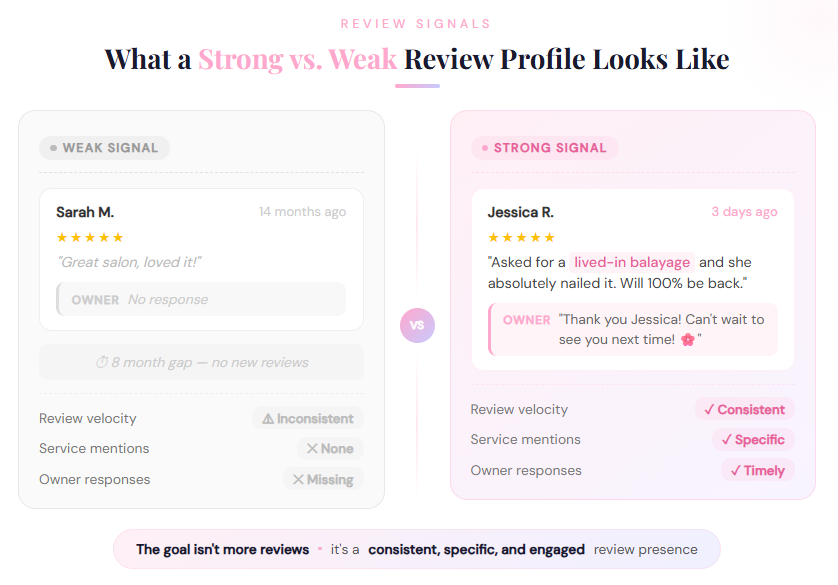
The three things that actually shape your review signals:
- Review velocity –This is the big one that gets overlooked. It's not about getting 50 reviews in a week and then going quiet. It's about a steady, believable drip of new reviews over time. Ten reviews a month for six months will outperform sixty reviews in one month, followed by silence. Consistency reads as health.
- Review quality – A review that says "great salon, loved it!" is fine. A review that says "asked for a lived-in balayage and she absolutely nailed it, will 100% be back for my next appointment" is significantly better. Detailed reviews that mention specific services or experiences help Google understand what you offer.
- Review responses – A lot of salons respond to the occasional glowing review and ignore the rest. That's a missed opportunity. Timely, thoughtful replies to positive as well as negative reviews show that you’re active and you care about your customers.
Individually these might seem small. Together, they build credibility in a way that's hard to replicate quickly.
Create Location and Service Landing Pages
This is an area where a lot of salon websites leave visibility on the table.
Many salon websites describe all services on one main page. That may be enough in smaller towns. In larger cities, it usually isn’t.
Search engines try to match specific searches with specific pages. If someone searches for bridal makeup in Dallas or keratin treatment in Miami, Google looks for a page that clearly focuses on that service in that location. A general homepage often doesn’t provide enough detail.
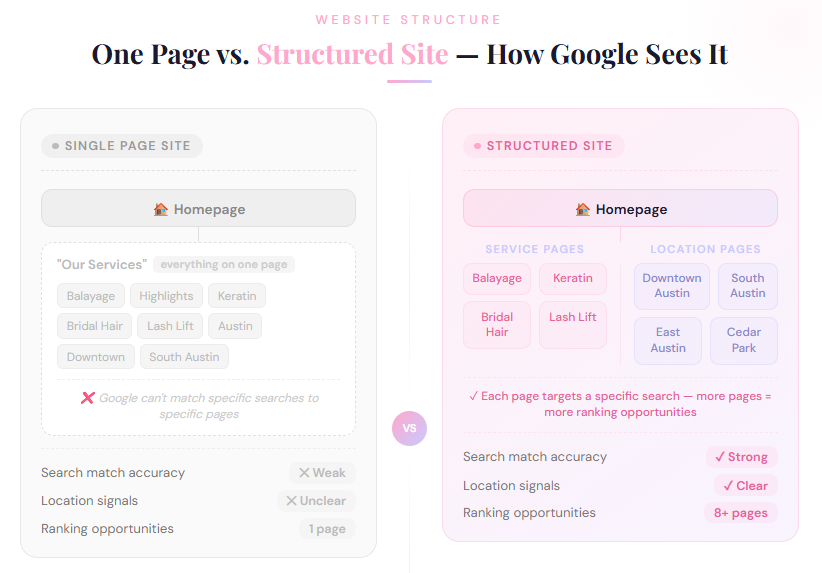
This is where structured landing pages help.
- Location pages - If you're pulling clients from multiple neighborhoods or nearby areas, a single address on your homepage isn't telling the full story. Dedicated pages for the areas you actually serve give Google something to match when someone searches from or for that neighborhood. It's a small investment that can open up searches you're currently invisible for.
- Service pages - Stop grouping everything under "Our Services" and calling it done. When you add service landing pages explaining individual treatments clearly, each page becomes a separate opportunity to show up in a specific search. One page for everything means one shot at visibility. Individual pages multiply that.
- Keyword targeting - And when you're writing these pages, write them the way your clients actually talk. Not "ocular lash enhancement," but lash lift. The goal isn't to stuff keywords in until it reads awkwardly. It's to describe what you do in the language people are actually typing into Google when they're ready to book.
When your pages are specific and well organized, search engines can understand your business more easily. And when they understand it clearly, visibility in turn improves.
Target High-Intent Local Keywords
Not every search has the same intent. Some people are browsing options. Others are ready to book right now.
This is actually where a lot of the real opportunity sits. Studies show that 88% of local mobile searches result in a call or visit within 24 hours, which means ranking for high-intent searches can directly influence bookings.

The searches worth targeting tend to look like this:
- “Near me” searches – These are people who've already decided what they want. They just need to find somewhere close. When someone searches for “hair salon near me” or “nail spa near me”, Google serves up businesses that are geographically close, clearly optimized, and specifically list the service being searched for. If your profile or website is vague about what you offer, you lose out even if you're two streets away.
- Service and location searches – Phrases like “balayage in Seattle” or “bridal makeup in Atlanta” show strong intent. These searches perform better when your website and profile clearly connect that service with that location.
- Clear service language – The way you describe your services should match how real clients search. If clients look for “lash lift” instead of “eyelash enhancement,” your content should mention that. Match how people talk, not how the industry talks.
None of this is about cramming phrases into your site until it reads like a robot wrote it. It's about making sure the language you use actually lines up with the language people use when they're ready to book, so when that search happens, Google has no trouble putting you in front of them.
Build Citations and Directory Listings
Citations are mentions of your business on other websites. These usually appear in online directories, mapping platforms, and industry listings. They're not glamorous, but they do matter.
The basic idea is this: Google is constantly cross-referencing your business information across the web. Every time it finds your name, address, and phone number on a trusted platform and it matches what's on your profile, that's a small confirmation that your business is legitimate and your information is accurate. Enough of those confirmations, across enough trusted platforms, and your overall credibility strengthens.
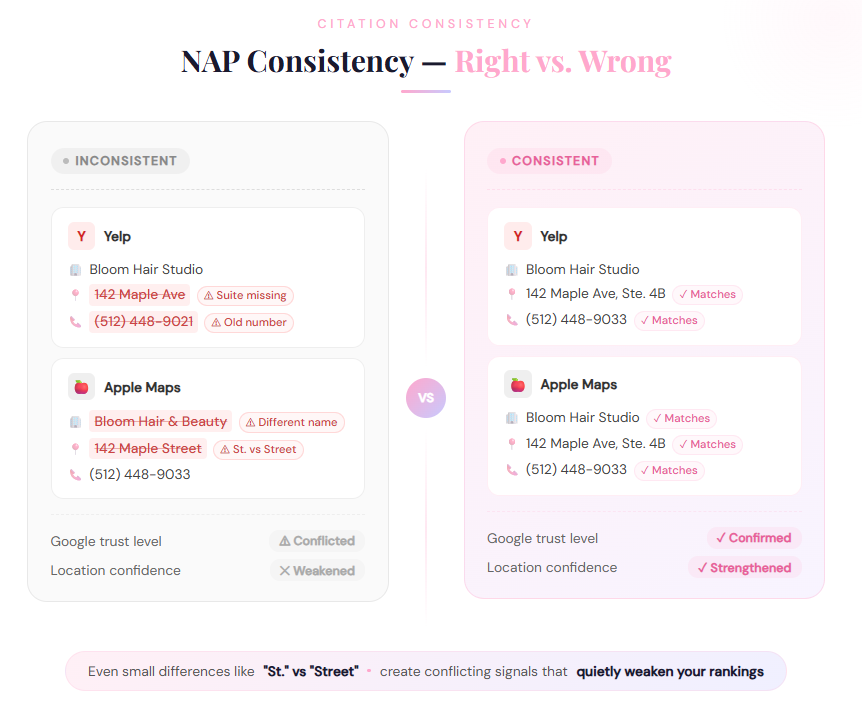
What actually matters here:
- Major directories – Listings on platforms such as Yelp, Apple Maps, Bing Places, and other reputable directories strengthen your business's online presence.
- NAP consistency – Your Name, Address, and Phone number should appear exactly the same everywhere. Even small variations can weaken trust signals.
- Authority signals – When your business is listed on recognized platforms, it sends a signal that your salon is established and verifiable.
Will sorting out your citations suddenly push you to the top of the Map Pack? Probably not on its own. But citations are part of the foundation everything else sits on. Get them wrong and they quietly undermine the other work you're doing. Get them right and they become one less thing working against you.
Stay Active in Local Ecosystem
This one often gets overlooked because it doesn't feel like "SEO work," but it feeds into prominence more than people realize.
When your salon participates in local community events and gets visibility online, it can, in turn, strengthen your prominence.
This can include:
- Events – Hosting or participating in local events, workshops, or shows can lead to mentions on local websites, social media posts, or event pages.
- Partnerships – Collaborating with nearby businesses, such as photographers, bridal boutiques, or wellness studios, can create cross-promotion and online references.
- Community signals – Local press mentions, blog features, sponsorships, and even tagged social posts contribute to your overall brand presence online.
Search engines interpret these mentions as signs that your business is established and connected within its community. It's the closest thing online SEO has to real-world word of mouth.
How Zoca’s Discovery Agent Helps You Improve Local SEO Rankings Consistently
By now, one thing should be clear. Improving local SEO rankings is not about completing a few tasks. It’s about maintaining relevance, reinforcing proximity, and steadily building prominence.
Most salon owners we talk to already know what needs to be done. The harder part is actually keeping it all going when you're also running a business.
Zoca’s Discovery Agent is built around that idea. Instead of treating local SEO as occasional updates, it creates a structured system that continuously optimizes them to strengthen your online presence.
1. Aligning With Real Local Search Demand
Local SEO rankings improve when your services clearly match what people in your area are searching for. If your profile emphasizes the wrong services or outdated terms, your visibility weakens.
Discovery Agent continuously aligns your business with real local demand by:
- Analyzing search behavior within your service radius to understand what people nearby are actively searching for
- Identifying high-demand keywords across broad, niche, trending, and seasonal service categories
- Conducting competitor visibility analysis to identify keyword gaps where your competitors rank and you do not
- Maintaining a strategic balance between high-volume competitive terms and lower-volume, higher-conversion niche terms
- Pinpointing low-competition opportunities where you can realistically break into the Map Pack
- Updating your Google Business Profile services and website content to reflect selected priority terms
- Adjusting emphasis based on seasonal demand shifts and trend changes
This strengthens relevance and boosts your visibility for high-intent searches.
2. Optimizing and Maintaining Your Google Business Profile
An optimized Google Business Profile plays a major role in rankings. It must be complete, accurate, structured correctly, and active, not just set up once and forgotten.
Discovery Agent manages this by:
- Claiming, verifying, and fully completing your profile to ensure accuracy and control
- Structuring primary and secondary categories, services, attributes, and pricing clearly
- Optimizing your business description with locally relevant search terms
- Ensuring strict Name, Address, and Phone consistency with your website and directories
- Managing business hours, including special holiday hours
- Maintaining high-quality photos while removing irrelevant or low-quality images
- Supporting steady review collection and professional responses to maintain strong rating signals
- Publishing consistent Google posts with clear calls-to-action to keep the profile active
A verified, complete, and consistently active profile is often what separates the businesses in the top three results from everyone else.
3. Maintaining Consistent Listings Across Directories
Search engines validate your business by checking if your information matches across platforms. Any kind of inconsistency weakens trust signals.
Discovery Agent strengthens citation consistency by:
- Creating and cleaning up listings across major directories
- Synchronizing your Name, Address, and Phone number
- Removing outdated or duplicate listings
- Expanding your presence across additional trusted platforms
This improves authority and geographic accuracy.
4. Aligning Your Website With Local Ranking Signals
Your website must support your Google listing. If services, keywords, or location signals do not align, visibility can suffer.
Discovery Agent improves website alignment by:
- Structuring dedicated service pages clearly
- Implementing local schema markup
- Optimizing page speed and Core Web Vitals
- Ensuring mobile-first performance
- Aligning on-page keywords with your GBP positioning
5. Monitoring and Refining Visibility Over Time
Local SEO is not static. Demand changes, competitors adjust, and search behavior evolves. What's working today might need tweaking in six months.
Discovery Agent maintains visibility by:
- Tracking keyword impressions and ranking trends
- Identifying areas where visibility drops
- Adjusting service emphasis based on performance data
- Refining optimization to maintain steady momentum
This keeps your rankings from fluctuating due to inactivity.
How Zoca’s Discovery Agent Builds a Consistent Local SEO System
Everything we've covered in this post comes back to one thing: consistency. Not doing it perfectly once. Doing it regularly, over time, without letting it slip when life gets busy. That's what actually moves rankings, and that's exactly what most salon owners struggle with, not because they don't care, but because they're running a business.
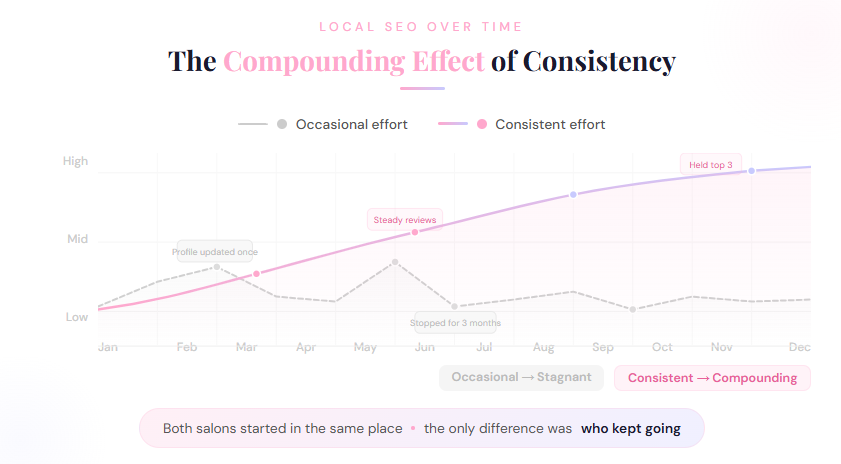
Automation vs. Manual Effort
Here's the reality of managing local SEO manually: it works great right up until it doesn't. You optimize your profile, sort out your listings, get a good review cadence going, and then you have a packed few weeks, a staff change, a new service launch, and suddenly it's been two months since anything was updated. That's not a discipline problem. That's just what happens when you're busy.
Discovery Agent removes that dependency. Demand alignment, profile optimization, listing synchronization, and monitoring it runs in the background continuously, so your core ranking signals don't quietly decay every time your attention is needed elsewhere.
Continuous Signal Strengthening
Google doesn't respond to bursts of activity. It responds to patterns. A profile that's consistently active with regular review responses, updated services, aligned listings, and fresh content builds authority gradually in a way that a one-time optimization push simply can't replicate.
What Discovery Agent does is keep all of those signals pointing in the same direction, all the time. Categories, services, reviews, listings, website alignment– none of it gets left to drift. Because the moment one piece starts to slip, the whole picture gets a little muddier, and rankings follow.
Long-Term Visibility Growth
The salons that hold strong local rankings over time aren't doing anything dramatically different from their competitors. They're just not stopping. That's genuinely most of it: showing up consistently when everyone else has quietly moved on to something else.
Local SEO compounds the same way reputation does. The longer your signals stay strong and aligned, the more authority you accumulate, and the harder that position becomes to displace. Discovery Agent is built around that idea– not a quick spike in visibility, but steady, compounding growth that holds up over time because it never really stops.
Conclusion
As we read above, local SEO rankings are built on signals. Relevance, proximity, and prominence determine who appears in search results, and those signals strengthen when your services align with demand, your listings stay consistent, and your profile remains active.
The businesses that rank well locally aren't usually doing anything secret. They're just doing the fundamentals, and they're doing them consistently.
If you want local SEO handled as a system that supports long-term growth, book a demo with Zoca and review your current visibility in detail.
Frequently Asked Questions
- How do I get my salon to rank #1 on Google?
There is no guaranteed way to rank #1 on Google because rankings depend on relevance, proximity, and prominence. However, you improve your chances by optimizing your Google Business Profile completely, aligning your services with high-intent local keywords, maintaining steady review activity, ensuring consistent business listings across directories, and keeping your website fast and well structured. In most cases, ranking #1 is the result of sustained consistency rather than any single action.
- How can I get my business to the top of Google Maps?
To appear at the top of Google Maps, your business needs strong local signals. This includes accurate categories, detailed services, high-quality photos, consistent NAP information, steady review momentum, and alignment between your website and Google Business Profile. Google prioritizes businesses that appear relevant, nearby, and credible. All three matter. Focusing on just one usually isn't enough.
- Why is my competitor ranking higher than me on Google?
Your competitor may have clearer service alignment, more consistent reviews, stronger citation accuracy, better website structure, or stronger local brand signals. Even small differences in consistency and profile completeness can influence rankings over time.
- How long does it take to rank higher on Google Search Results?
Local SEO improvements typically take several weeks to months, depending on your location and competition. There's no way to rush it significantly. Ranking changes happen gradually as Google detects consistent signals and increased engagement patterns.
- Can I rank #1 without paying for ads?
Yes. Organic rankings are not paid placements. While ads appear above local results, organic rankings depend on relevance, proximity, and prominence. A well-optimized local presence can earn visibility without ad spend.
- What is the fastest way to improve local SEO rankings?
There is no shortcut, but the fastest improvements often come from fixing foundational issues. This includes completing and optimizing your Google Business Profile, correcting inconsistent listings, improving website speed, and aligning services with high-intent keywords. These foundational fixes can produce noticeable movement more quickly than isolated tactics.